A $7.31 A Bathing Ape crew-neck in dozens of colourways: 100% cotton at 250–300 gsm, a Japanese cut that runs close, and a monkey-head print that needs one size up and a cold wash.
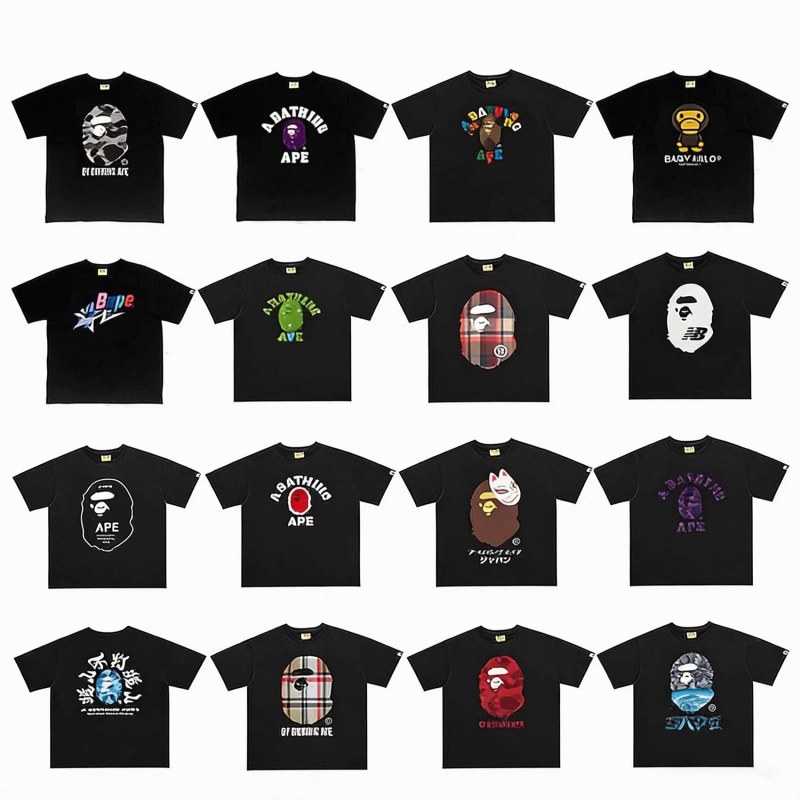
Hands-on score4.0 / 5
Editor verdict
A $7.31 cotton graphic tee that delivers the monkey-head look and a 250–300 gsm body, but the Japanese cut runs close and sizing reports conflict. Order one size up, check the warehouse photos, wash cold.
What works
- Dozens of colourways across eight coded families, plus black1/2/3 and white1
- 100% cotton, 250–300 gsm, breathable crew neck at $7.31 USD
- Owners report screen prints lasting years on cold wash and air dry
Watch-outs
- Sizing reports conflict; one reviewer around 180 cm found XL too snug
- Some dedicated and tax-free shipping lines exclude branded goods
- One buyer reported a chemical smell on unbagging, and fabric feel has changed
Who this may suit
Buyers who want a midweight cotton monkey-print crew neck in a specific colourway, will check the size chart instead of the letter size, and are building a consolidated haul.
Who may want to skip
Buyers who need one consistent sizing answer, are sensitive to odour straight out of the bag, machine dry their tees, or want a single item shipped alone at minimum freight.
The BAPE classic monkey-print tee is the cheapest way into A Bathing Ape's graphic language and the item most often dropped into a streetwear haul first. We ordered the Bape Classic Monkey Print T-Shirt Collection through Kakobuy — painted reference price $8.41 USD, current listing $7.31 USD, SKU 7715767163, in stock when we checked — and followed it from the domestic leg into the warehouse photo set. Here is what the design actually looks like, how the Japanese pattern behaves on a Western frame, and what a sub-300-gram garment really adds to a consolidated parcel.
Design and colourway: one monkey head, dozens of pairings
This is a short-sleeve pullover crew neck with a round neckline, regular sleeve, straight hem and a printed front. The graphic is the familiar pairing: the monkey-head motif above the A Bathing Ape wordmark, both rendered in a single accent colour on a white or black base. The listing describes the body as 100% cotton in a plain-weave pure cotton fabric, 250–300 gsm, breathable, normal thickness, cut in a loose, street-leaning shape for summer casual wear.
The colour list is where the real decision sits. Sizes run S to XXL, and the options fall into eight coded families plus four ungrouped colours. Every family pairs a white or black base with one accent colour, so choosing is really two steps: light base or dark base, then accent.
| Family | Base | Accents listed |
|---|---|---|
| D167 | White or black | Red, yellow, grey, blue, green, brown, light green, purple, cyan |
| D168 | White or black | Same wide accent run as D167 |
| D115 | White or black | Brown, blue, grey |
| D169 | White or black | Blue, green, pink |
| D170 | White or black | Pink, green, blue |
| D081 | White or black | Red, cyan, blue, purple |
| D097 | White or black | Green, purple, red, blue |
| D109 | White or black | Blue, green, pink |
| Ungrouped | — | black1, black2, black3, white1 |
Two practical notes from our sample. A black base is more forgiving of print wear and everyday soiling on a graphic tee, while a white base makes the accent colour read louder and shows edge bleed more clearly. If you do not want to study family codes, the ungrouped black1/2/3 and white1 are the least ambiguous picks.
The cut: a Japanese pattern and the one-size-up rule
The listing calls the fit loose, and the garment does have a straight hem and a generous body. The catch is that a Japanese-drafted block reads closer to the torso than a US or EU relaxed fit at the same labelled size, which is why "loose" here can land as "close" for buyers used to American proportions. Buyer reports split on exactly this point:
"I would call it Asian sizing. I normally wear XL with 5.11 and Gap tees. When it comes to Evisu and Bathing Ape I go XXL."
Other owners call the tees true to size and advise going up only if you sit between sizes. A video reviewer around 180 cm and 88 kg found the XL too snug for his taste. The listing also states a 2–3 cm measurement tolerance, which is wide enough to push a body measurement across a size boundary. Our working rule: measure the chest of a tee that already fits you, add 4–6 cm for the relaxed street look, and choose the chart size at least that wide. For most buyers coming from US sizing, that lands one size up.
What the warehouse photo set needs to show
Print placement is the product here, so the quality-check set has to prove registration, not just colour.
- The front photographed flat and unfolded, with the whole monkey head and wordmark inside the frame.
- The print edge: sharp, matte and evenly filled, with no smearing, gloss or haloing into the base fabric.
- The collar ribbing: even width, sitting flat in the base colour, with no puckering where it meets the shoulder seam.
- The neck label and size tag, legible, matching the size you ordered.
- Hem and sleeve stitching, plus the care label.
If the only front shot is folded so the monkey head is cut off, or the set is styled on a hanger instead of laid flat, request extra angles before approving consolidation. Fixing a wrong colourway or a misprinted graphic costs almost nothing at the warehouse and is close to impossible once the parcel has left China.
Inside a consolidated haul: weight, storage and landed cost
The mechanics are straightforward. You pay the item price plus the China-side domestic shipping that carries the parcel to the KakoBuy warehouse; the warehouse logs it, runs the free quality-check photo set, and holds it. Storage is advertised as a free window — KakoBuy's own guides cite 100 days, while some third-party comparisons still quote 90 — and the clock starts when each item reaches the warehouse. Terms like this change, so confirm the current window on the official site before you plan a haul around it.
The catalog feed does not publish a garment weight, so shipping estimates have to come from the packed parcel. Our sample — one 250–300 gsm cotton tee in its polybag at the warehouse stage — settled near 0.3 kg, and a heavier size or a boxed parcel adds to that. A tee this light barely moves a shipment on its own; what matters is which whole-kilo bracket you land in.
| Scenario | Packed weight | Where the cost sits |
|---|---|---|
| Tee shipped alone | About 0.3 kg | Minimum or first-weight charge dominates; highest effective cost per kilo |
| Tee added to a 4–5 kg haul | About 0.3 kg incremental | Pays roughly its share of the per-kilo rate; the cheapest realistic route |
| Two or three tees added | About 0.3 kg each | Small increments, but check for a jump into the next whole-kilo bracket |
Every rate and bracket above is illustrative and subject to change. Line availability, per-kilo pricing and volumetric rules differ by destination and shift through the year, so confirm live pricing and current policy on the official KakoBuy site at checkout. Two points matter specifically for this item: some dedicated and tax-free lines exclude branded goods, so read the line's restrictions before consolidating, and US-bound parcels no longer receive the old low-value duty-free treatment, so budget for possible duty and brokerage on top of the quoted freight.
Where the evidence is thin
Three points remain open, and we are not going to close them from a single sample. Sizing reports genuinely conflict, which is why we lean on measurements rather than letter sizes. A retail buyer reported that current Bape tee cotton feels smoother and cooler than the older, slightly coarser fabric. And one buyer reported a faint formaldehyde-like smell when unbagging a tee — if odour sensitivity is an issue for you, ask the warehouse to air the garment and raise it with the agent while the item is still in storage. Longer-term owners also report that screen prints hold up for years on a cold wash and air dry, and blame machine drying for cracked prints.
Before you order
Pick your size and colourway from the catalog listing rather than from a saved screenshot, because that page is the verified product behind this review. Choose the family code and base colour first, confirm the size against the chart, then let the tee sit in free storage until the rest of the haul arrives. Every price, storage and shipping figure mentioned here is subject to change, so confirm the live numbers on the official site before you pay.
How we tested
We ordered the tee at retail, photographed the packaging, and logged chest, shoulder and length measurements against the size chart. We weighed the polybagged garment before consolidation, then cold-washed and air-dried it three times to check the monkey-head print registration and collar ribbing.
Does the free quality-check photo set give me enough angles, or can I request more?
The standard set is free, and extra or macro shots usually carry a small fee. If the first set does not show the print clearly, ask for additional angles while the tee is still in storage rather than after consolidation.
Can I return the tee if the warehouse photos show a defect?
That is what the warehouse stage is for. Once an item is logged as stored, buyers typically have a short window to request a return or exchange if the photos reveal a fault. Confirm the current terms on the official site.
Will I owe import duty on a $7 tee?
Possibly. The United States ended duty-free de minimis treatment for low-value China-origin parcels in 2025, so budget for potential duty and brokerage on top of the freight quote.