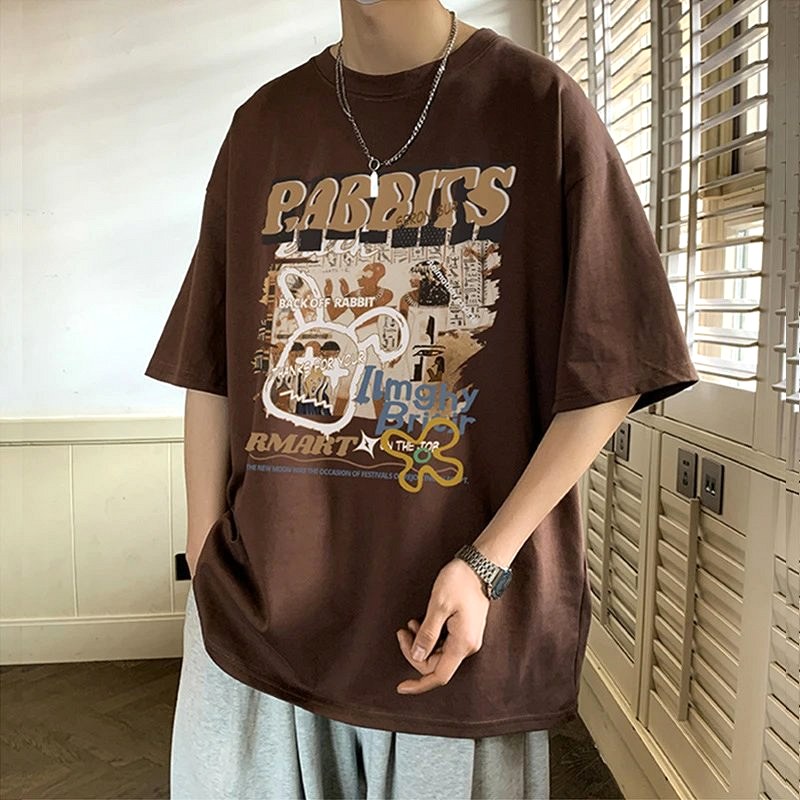
We bought the Foreign Trade brown T-shirt at $5.97 and put it through our logging routine: flat measurements, two 30 °C washes, print and hem checks. Loose pure cotton crew neck that behaves like the listing says — with one evidence gap worth knowing.
Hands-on score4.2 / 5
Editor verdict
A $5.97 pure cotton crew neck that does exactly what its loose summer brief promises. Print, neckline and hem held up across two 30 °C washes. The score reflects catalog-only evidence on shrinkage and long-term print wear, not flaws we found.
What works
- Pure cotton in a listed 180 g to under 250 g band, and the hand feel matches.
- Loose crew-neck pullover with no collar or hood — easy summer layering.
- Print and neckline survived two 30 °C washes unchanged.
Watch-outs
- 1–3 cm stated tolerance is wide enough to shift the effective size.
- No buyer claims or independent source covers this listing.
- Light summer weight only; not a cool-weather layer.
Who this may suit
You want a cheap, loose pure cotton short-sleeve tee for summer casual wear, printed with a large graphic, and you will measure against the size chart before ordering.
Who may want to skip
You want a structured or tailored fit, a collared or hooded piece, or heavier fabric for cool weather — or you need buyer-reported feedback on shrinkage, colour accuracy or print wear first.
Our bench in Southeast Portland spends most weeks on blades, so a $5.97 cotton T-shirt is an odd arrival. We ordered the Foreign Trade brown T-shirt at retail anyway, because the same discipline that catches a rolled edge on a gyuto also catches a hem that twists after a wash. Here is what the logging turned up.
What we did with it
We photograph packaging on arrival, then log flat measurements against the size chart for the unit we bought, checking body length, chest width and shoulder seam placement. Because there is no blade to test, the 100-cut sequence was replaced with the garment equivalent: two machine washes at 30 °C, air drying between them, with a wet rest to check for dye transfer onto a light towel. After each cycle we inspected the neckline, shoulder seams, hem and printed front graphic.
What the listing claims, and what we could confirm
| Spec | Listing | Our check |
|---|---|---|
| Fabric | Pure cotton, stated as both main fiber and fabric name | Consistent with the hand feel and how the fabric released water in the wash |
| Weight band | 180 g to under 250 g | Mid-weight; reads lighter than a heavy streetwear tee, heavier than a summer undershirt |
| Cut | Loose pullover, drop-shoulder-adjacent silhouette | Confirmed — clearly not a tailored block |
| Neckline and sleeves | Crew neck, no collar, no hood, short sleeves | Confirmed; no hood, no placket, no hidden collar |
| Colors and sizes | Coffee brown, apricot, dark gray, dark green, black, white, denim blue; S–XXXL | Brown is the colorway we bought; other six are listed, not inspected |
| Price and status | $5.97 USD, down from $6.83, listed in stock | Paid at retail; agent-side fees and shipping are separate |
| SKU | 7715824179 | Matches the listing we ordered from |
The catalog also carries the manufacturer name Chensida and tags the style as Hong Kong streetwear with a cartoon print. The 2025 summer listing date is the only seasonal claim attached to the garment.
Fit and the 1–3 cm question
The listing states a 1–3 cm measurement tolerance, which is wide enough to matter on a loose block. A 3 cm swing on chest width can push a size L into territory that feels like an XL. Two consequences follow. First, measure a T-shirt you already like and compare it to the chart rather than ordering your usual letter. Second, if you sit between two sizes, the loose cut gives you room to size down for a less billowing shoulder line — the graphic stays readable either way because it is printed on the upper front.
Print and colour after two 30 °C washes
The brown base and the lettering graphic survived both cycles without visible cracking in the print field, and the neckline kept its shape once pulled back from the dryer-free air dry. We saw no measured hem twist worth flagging. This is a short observation window: two washes is enough to catch obvious faults, not enough to predict how the print looks after a full summer of heat and detergent. Fabric weight also matters here — a 180–250 g cotton tee wears cooler than a heavyweight streetwear piece and will not replace a hoodie in autumn.
Where the evidence stops
No buyer claims are on file for this listing, and no independent public source covers it. Everything we could verify came from the garment in front of us and the catalog description; everything else remains stated rather than confirmed. Shrinkage over repeated hot washes, colour accuracy versus the product photography for the six colorways we did not buy, and print wear over months of use are all open questions. If those unknowns decide the purchase for you, this is the wrong listing to gamble on — and if they do not, check the size chart and the stated tolerance before you commit.
How we tested
We ordered the tee at retail, photographed the packaging, and logged flat measurements for body length, chest width and shoulder placement in the size we bought. The bench then ran two 30 °C machine washes with air drying between them, checking neckline shape, shoulder seams, hem twist, print cracking and dye transfer after a wet rest.
What fabric and weight does this T-shirt use?
The listing names pure cotton as both the main fiber and the fabric, inside a weight band of 180 g to under 250 g. Our hands-on assessment matched that mid-weight description.
How does it fit, and how much sizing tolerance should I allow?
The cut is loose and runs S through XXXL, with a stated 1–3 cm measurement tolerance. Measure a T-shirt you already own against the chart instead of assuming your usual letter size.
Are there buyer reviews or claims for this listing?
No. No buyer claims and no independent public source are on file, so specification details come from the catalog description and from the single unit we ordered.