# Carhartt Jacket: Itemize Cross-Border Shipping Costs 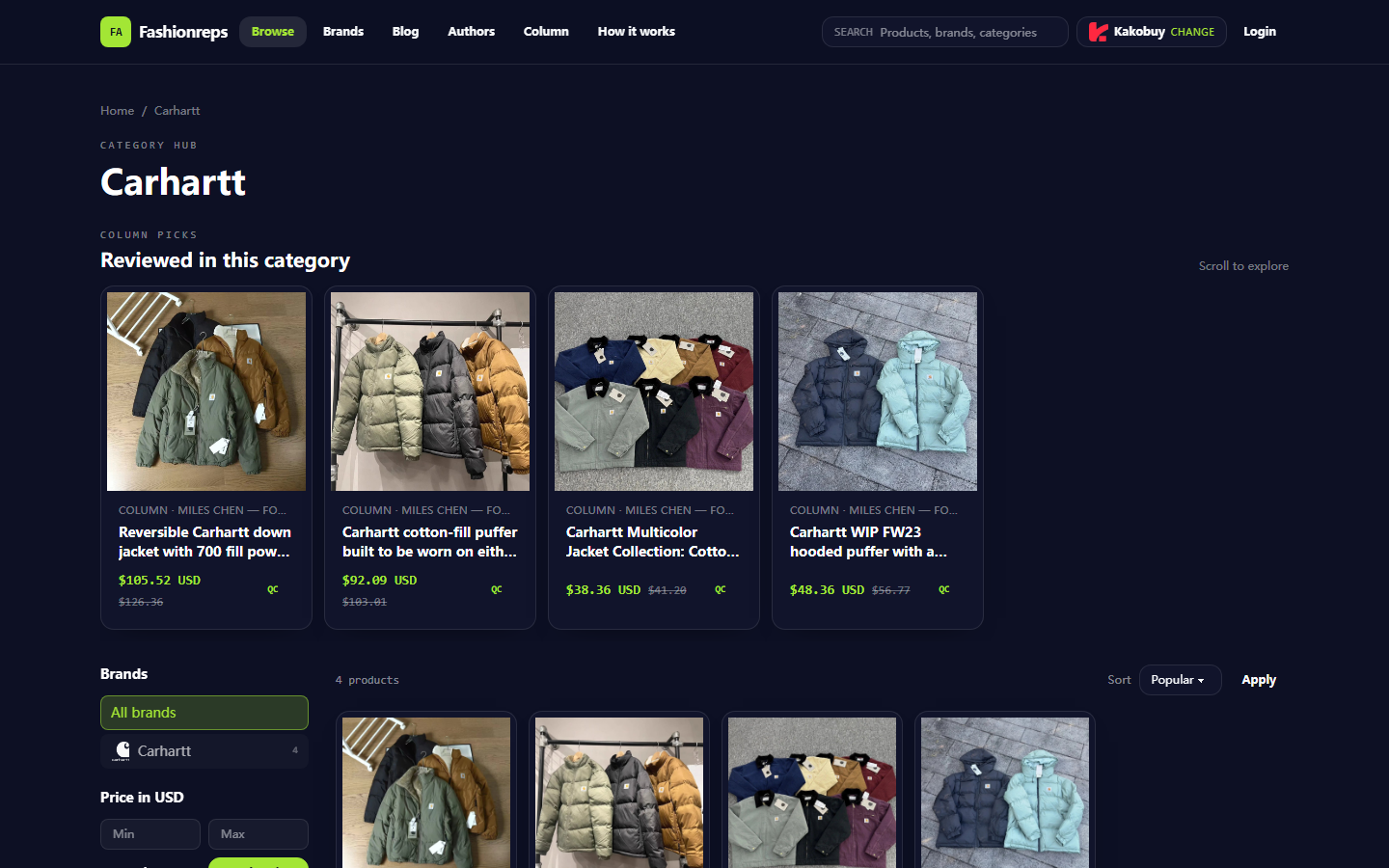

Image: fashion-reps Carhartt category page and visible shopping agent entry points. Page info recorded on October 9, 2026; image used to illustrate product classification and process entry points, not actual parcel costs or shipping commitments.
Scope and Evidence Limits for Carhartt Work Jacket Parcel Cost Checks
This guide addresses a specific problem: you've already found a Carhartt work jacket on fashion-reps and are about to purchase through the shopping agent shown on the page, but you don't know how to itemize and verify the final parcel costs.
After reading, you should be able to do three things: separately record the product price, agent service fees, payment fees, packaging fees, international shipping, and possible taxes; compare routes under the same destination and currency; and stop payment or shipment confirmation when key information is missing.
This article only discusses cross-border parcel cost recording and does not replace the latest rules from destination country customs, tax authorities, or agent websites. The fashion-reps page displays product discovery, categories, and shopping agent entry points; orders, payments, and international shipping are handled on the selected agent's website. Therefore, you cannot treat the reference price on the category page as the final landed cost, nor treat the agent names listed on the page as currently available quotes or shipping guarantees.
This article has no verifiable real-time agent quotes, route price lists, parcel weighing records, or destination country tax data, so it does not provide specific shipping cost figures. All costs should be based on your chosen agent's backend, payment page, warehouse weighing records, and official requirements of the destination country. ⚠️
Recording Style, Specs, and Visible Prices from the Fashionreps Product Page
First, save evidence that is directly visible on the product page, then go to the agent website for inquiry. The Carhartt category page displays several different jacket samples, including reversible down jackets, cotton-filled jackets, multicolor jacket collections, and Carhartt WIP hooded jackets. Their fill, outer material, length, hood type, and packaging volume may differ, so you cannot estimate parcel costs based solely on the name "Carhartt jacket."
It is recommended to create a separate record for each candidate product:
- Product title and page category.
- Reference price and currency shown on the product page.
- Original price or previous reference price shown on the product page, if still visible.
- Color, size, style, whether it has a hood, and structures that may affect volume.
- Whether the product page provides a size chart, material description, or other visible specifications.
- Page access date and screenshot file name.
- The agent website actually redirected to and its order number, if an order has been created.
The USD price on the page is only suitable as a record of the product price and cannot directly represent the agent settlement amount. Also confirm whether the price varies with size, color, inventory, promotions, exchange rates, or seller page changes. If the page only shows a reference price and no current orderable price, mark it as "pending agent confirmation" and do not calculate the final total based on that.
At the same time, verify product identity. The product title, style description, and page images should correspond to the same jacket; if the redirected agent page shows a different product, lacks specifications, or cannot be opened, pause recording and do not substitute a similar style.
Checking Packaging Method, Volume, and Chargeable Weight Information
After the warehouse receives the goods, the focus of cost checking shifts from the product page to parcel data. The actual weight of the clothing and the chargeable weight after boxing are not the same field. The agent may use actual weight, volumetric weight, or route-specific billing rules, and which one is ultimately used must be checked in the current route description and settlement page.
At least record the following fields:
- Actual weight of a single item.
- Total actual weight of all items in the parcel.
- Length, width, height, and measurement unit of the outer box.
- Chargeable weight or volumetric weight shown on the page.
- Whether shoe boxes, brand packaging, hangers, or excess filler are removed; only record options explicitly provided by the agent.
- Whether packaging reinforcement, compression, waterproofing, or special packaging incurs extra fees.
- Weight and volume before and after parcel adjustment, and the reason for adjustment.
- Weighing time, warehouse name, and corresponding parcel number.
Do not guess clothing weight based on a product display image, and do not write appearance judgments like "lightweight" or "puffy" as billing basis. Down or filled jackets may change volume significantly after compression, and heavy workwear fabric may result in higher actual weight than ordinary coats. Only data from warehouse measurements or agent quote pages can enter cost calculations.
If the agent allows multiple packaging treatments, first confirm the impact of each treatment on weight, volume, damage risk, and compensation conditions. Compression packaging may reduce volume but increase wrinkles or affect jacket shape; removing outer packaging may reduce volume but change acceptable condition for returns or exchanges. ⚖️
Recording Agent Service Fees, Payment Fees, and International Shipping by Destination
To avoid mixing different fees, it is recommended to record by order stage. The product payment stage usually confirms only the product price and possible local handling fees; reliable packaging and international shipping data are only available after the goods arrive at the warehouse and the parcel is submitted.
| Fee Item | Evidence to Record | Key Check Points |
|---|---|---|
| Product Price | Product page or agent order page | Whether product, size, color, currency, and inquiry time are consistent |
| Agent Service Fee | Agent settlement page or fee description | Whether charged per order, item, parcel, or service type |
| Payment Fee | Actual payment page | Payment method, currency, exchange rate, and whether additional handling fees apply |
| Packaging Fee | Warehouse packaging options and final bill | Whether reinforcement, compression, waterproofing, packaging removal are separately billed |
| International Shipping | Route quote, parcel weight, and destination | Chargeable weight, route restrictions, remote areas, and quote validity |
| Taxes or Customs Fees | Destination country official requirements or carrier notice | Declaration responsibility, tax bearer, and possible additional payment conditions |
When comparing routes, you must fix the destination, currency, parcel content, and weight basis. You cannot directly compare one route's estimated price with another route's actual settlement price, nor mistake exchange rate changes on different dates as the route itself becoming cheaper.
It is recommended to keep a calculation note outside the table, such as: "This record only covers product price, displayed agent fees, and international shipping at warehouse submission; taxes, customs duties, and destination country handling fees are not included and must be confirmed separately according to the latest requirements of the destination country and carrier." This avoids writing unoccurred or unverified fees as definite amounts.
Check the payment currency once more before paying. If the product page displays USD, the agent settles in CNY, and the bank card deducts in local currency, there are at least two possible exchange rate conversions. The actual deduction amount should be based on the payment page and bank statement, not a rounded mental calculation. 💱
Preserving Currency, Time, and Restrictions When Comparing Routes
The core of route comparison is not finding a number that looks lowest, but confirming that this number applies to your parcel. Each route should come with full conditions: destination country and region, inquiry date, parcel weight, dimensions, declaration method, allowable product categories, whether fuel or remote area surcharges are included, compensation limits, and estimated transit time range.
When recording routes, check item by item:
- Whether clothing with fill, heavy fabric, or special accessories is accepted.
- Whether there is a maximum weight, size, or declared value per shipment.
- Whether specific declaration documents are required.
- Whether the quote is an estimate or the final post-weighing price.
- When volumetric weight applies, which calculation method the route uses.
- Whether customs brokerage service is included, or the recipient handles it.
- Scope of liability for loss, damage, return, and refusal.
- Whether the quote is valid only for a short period.
When customs is involved, you must declare truthfully according to the actual contents and destination country requirements. Do not undervalue, split orders to avoid taxes, or evade inspection to reduce costs. If a route's required documents, restrictions, or tax responsibilities cannot be confirmed, delay choosing that route and verify with the agent or official destination country channels. 🛃
Building a Pending Verification List When Official Fee Data Is Missing
When the agent website does not have a complete public price list, or the settlement page has not generated a quote, the most reliable approach is to create a "missing field list" rather than filling numbers with old online screenshots or another user's one-time bill.
Before submitting an inquiry or contacting the agent, prepare the following information:
- Destination country, state or province, city, and whether it is a remote area.
- Carhartt jacket product link, style, size, and quantity.
- Measured actual weight, outer box dimensions, and chargeable weight from the warehouse.
- Whether consolidation, packaging removal, reinforcement, or waterproofing is needed.
- Whether other clothing or items are shipped together.
- Names of routes to compare and acceptable transit time range.
- Tax, customs, compensation, and return conditions that the agent must clearly answer.
After receiving a reply, convert verbal explanations into retainable written quotes or order page records. If only vague answers like "usually about the same" or "approximately this range" are given, do not rewrite the estimated range as a fixed fee.
When official or order-level data is missing, this article can help you determine what to ask, but cannot calculate specific amounts for you. Especially do not derive international shipping from product page reference prices, or derive current quotes from order screenshots of other countries, other weights, or other dates.
Cost Record Table and Stop Order Conditions
The following record table is suitable for filling after the goods arrive at the warehouse. The amount column should be left to the agent settlement page, payment page, or official fee notification, not filled based on experience.
| Record Item | What to Fill In | Handling When Missing |
|---|---|---|
| Product Info | Style, size, quantity, product page date | Return to product page for re-verification |
| Product Amount | Amount, currency, order time | Do not use old reference price as substitute |
| Warehouse Data | Actual weight, dimensions, chargeable weight, measurement time | Request supplementary measurement evidence from warehouse |
| Packaging Plan | Selected treatment and cost | Confirm whether it affects compensation or returns |
| Agent Fees | Service fee, payment fee, and charging basis | Check current settlement page or fee description |
| International Shipping | Route, quote, destination, and validity | Obtain order-level quote |
| Tax Liability | Declaration requirements, bearer, and possible costs | Check destination official requirements and confirm with agent |
| Final Total | Confirmed amounts and excluded items | Unconfirmed items must not be written as zero fees |
Stop placing an order or submitting a parcel if any of the following occurs:
- Product style, size, or agent order information cannot be matched.
- Warehouse has not provided weight or dimensions, but agent demands immediate route selection.
- Quote does not specify currency, destination, or chargeable weight.
- Route restrictions may conflict with jacket material, fill, or parcel contents.
- Total amount on payment page does not match fee breakdown.
- Taxes, customs responsibility, or declaration requirements cannot be confirmed.
- Agent requests unnecessary complete payment card, passport, or other sensitive information.
- Route advertises a very low price but has no validity period, compensation conditions, or complete restriction description.
Final Action Checklist Before Submitting Carhartt Parcel
Before submission, review in the following order:
- Confirm the style, specifications, page price, and recording date from the fashion-reps product page.
- Confirm the actual selected shopping agent and its order page; do not treat the platform category page as an order voucher.
- Wait for the goods to arrive at the warehouse and save warehouse photos, actual weight, dimensions, and parcel number.
- Separately record product price, agent service fee, payment fee, packaging fee, and international shipping.
- Compare routes using the same destination, currency, and chargeable weight.
- Check route restrictions, declaration requirements, tax liability, return, and compensation conditions.
- Obtain written confirmation from the agent for all missing or ambiguous fields.
- Submit the parcel only when the total, responsibilities, and restrictions can be clearly explained.
This recording method may help you reduce repeated inquiries, discover hidden fees, and avoid mistaking estimated shipping for the final bill. It also adds some organizing time and cannot eliminate risks from exchange rate fluctuations, warehouse re-weighing, carrier adjustments, or destination country tax changes.
This method is suitable for buyers who need to compare agent routes for one or more Carhartt jackets, retain cost evidence, and control unexpected expenses. It is not recommended to pay directly based solely on category page prices or others' old bills when product specifications, warehouse weight, route restrictions, or tax liability have not been confirmed.
Article Image
Agent Platform Shopping FAQ
1. What should I do if I am not happy with the item I received on uufinds.tips?
Reach out to the customer service team on uufinds.tips as soon as possible. Most regular items from Chinese sellers include a 5-day unconditional return and exchange policy. If you are dissatisfied, you may ask for a return. If the package has already left the warehouse and reached your address and you find a quality problem, you must contact uufinds.tips customer service so they can assist you in contacting the seller to work out a compensation plan.
These are the customer service email addresses for each platform:
kakobuy: service@kakobuy.com
oopbuy: support01@oopbuy.com
usfans: support@usfans.com
hipobuy: care@hipobuy.com
superbuy: care@superbuy.com
2. What do QC photos mean on uufinds.tips?
Every drop-shipping platform, including uufinds.tips, employs quality control specialists. After your products arrive at the platform's warehouse, staff inspect the items and take QC photos. Usually three photos are captured, and the team checks that the color, size, specifications, and quantity match your order. They also look for quality issues. However, this does not apply to electronic products—only the exterior is inspected for those. If they find quality problems or wrong size or color, the team will immediately ask the seller for a return. This helps ensure you receive high-quality products.
3. What product categories can I find in the spreadsheet for uufinds.tips?
The website spreadsheet covers shoes, clothing, bags, accessories, jerseys, perfumes, hats, scarves, belts, and various household daily necessities.
4. Why should I use a spreadsheet on uufinds.tips?
Because agent platforms such as uufinds.tips generally do not show products directly, you need a spreadsheet to search for items you like and locate their purchase links. You could also ask for help on Reddit or Discord—the products recommended there are often great, but the buying process can be very slow. These spreadsheets are typically built over a long time by collecting information from those platforms.