## Define the Candidate Organization Task and Verification Boundaries If you are organizing Rolex watch candidates, the real issue is not "which tool is more advanced," but how to reliably consolidate candidate styles, product pages, image evidence, and source information from a website directory into a reviewable checklist. This article is for people who need to browse candidates first, then verify specifications, and collaborate with others. This article only discusses the division of labor be
Define the Candidate Organization Task and Verification Boundaries
If you are organizing Rolex watch candidates, the real issue is not "which tool is more advanced," but how to reliably consolidate candidate styles, product pages, image evidence, and source information from a website directory into a reviewable checklist. This article is for people who need to browse candidates first, then verify specifications, and collaborate with others.
This article only discusses the division of labor between the website-based Spreadsheet or product catalogue visible on fashion-reps and Google Sheets. The website pages are responsible for discovering and re-checking candidates, while Google Sheets handles structured recording, filtering, and collaboration. Neither can replace the verification of product information, seller pages, platform policies, destination country compliance requirements, and actual availability before purchase.
The verification cutoff for this article is October 12, 2026. Prices, inventory, link status, number of images, and available services on pages may change; if you purchase after publication, you should reopen the source pages to confirm. This article does not present unshown prices, inventory, materials, authenticity, or seller promises as confirmed facts. ⚠️
Locating Visible Candidates from the fashion-reps Website Catalogue
The website catalogue is more suitable for the first step: seeing what candidates exist, entering content by brand or section, opening product details, and then following the entry points provided on the product page to view images or QC information.
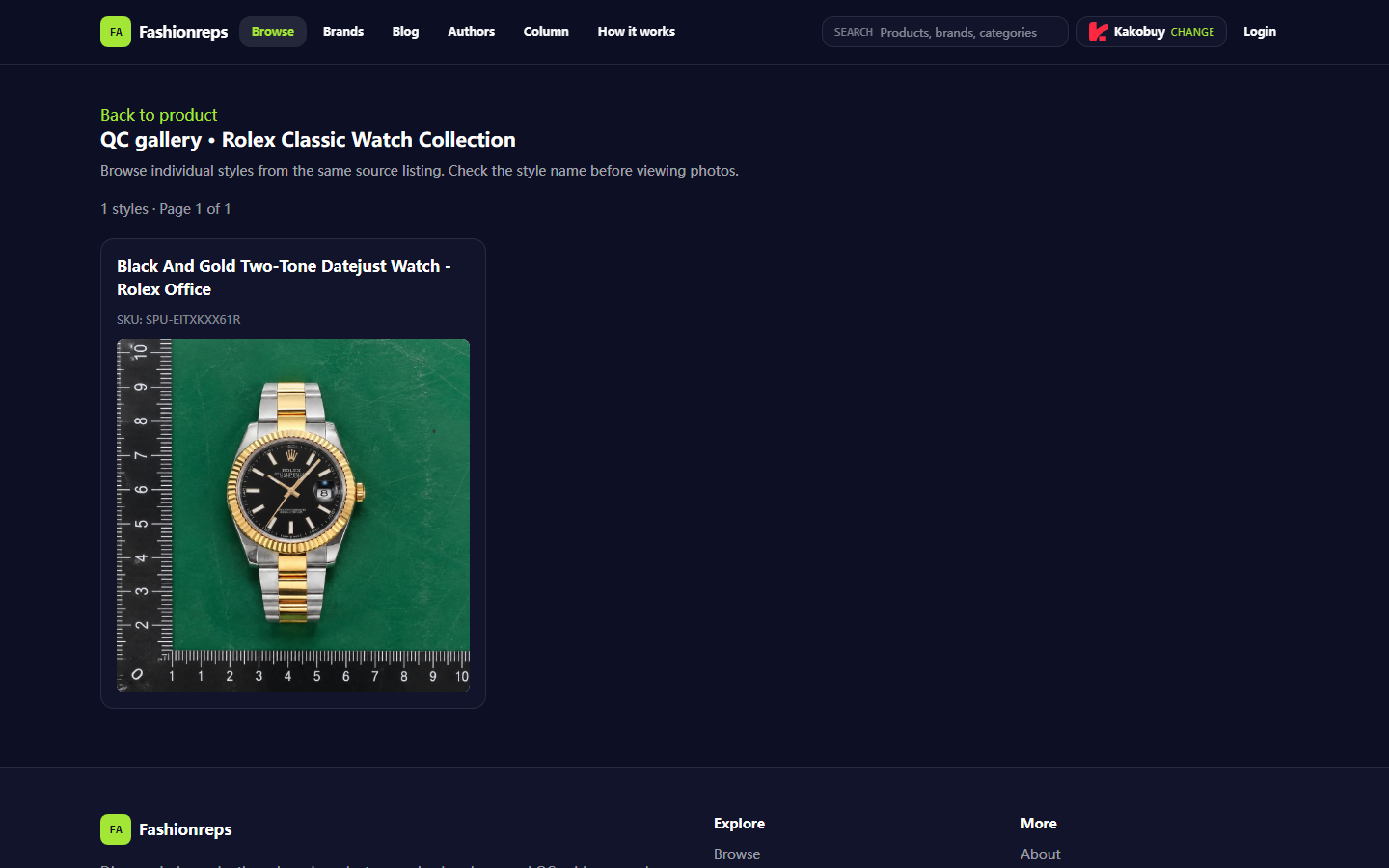
The currently visible page structure includes navigation entries such as Browse, Brands, Blog, Authors, Column, and How it works. Candidate detail pages also display product names, SKUs, or similar item identification information, and may provide QC image entry points. Taking the Rolex Classic Watch Collection page as an example, the page shows a Black And Gold Two-Tone Datejust Watch candidate style, and the detail page provides a path to enter the QC gallery.
Here, "candidate" only means that there is a viewable product entry in the catalogue; it does not mean the product is authentic, nor does it mean it is currently in stock. When trademark, replica, import restriction, or platform rules are involved, you should first confirm the destination country's laws and the purchasing platform's policies.
When browsing, it is recommended to follow this order:
- First confirm the product name and its collection to avoid mixing different styles from the same source.
- Then open the individual product page and record the visible style name, color description, SKU, and image entry.
- If the page provides a QC gallery, confirm each image actually corresponds to that style; do not assume collection page images are evidence for every style's physical item.
- For fields that do not show size, material, movement, strap, or inventory information, clearly mark them as "Not displayed."
- Do not judge brand authenticity, material grade, or after-sales guarantee solely based on Rolex or Datejust in the product title.

The image is used to illustrate the re-check relationship among website catalogue, product details, and QC entry, and does not represent proof of authenticity, material, or actual inventory.
How to Record Styles, Specifications, Colors, and Sources in Google Sheets
The value of Google Sheets is not to replace website browsing, but to fix the information scattered across pages. It is best to give each candidate one row and use a separate column for each fact, avoiding mixing multiple judgments into one note.
| Suggested Field | Recording Method | What to Write When Unconfirmed |
|---|---|---|
| Candidate Name | Copy the visible name from the product page | Do not complete the model number on your own |
| Collection or Category | Record the directory or collection name | Write "Not displayed" |
| Color and Appearance Description | Use the page's original description | Do not write image impressions as material conclusions |
| SKU or Item Identification | Record according to visible page content | Leave blank and note if missing |
| Size, Material, Movement | Only record what the page explicitly states | "Not displayed" or "Pending seller confirmation" |
| Product Page Source | Save the page URL or internal reference | Mark "Needs re-check" if the page fails |
| QC Image Status | Yes, No, Unable to confirm | Do not treat collection images as QC evidence |
| Last Verification Date | Enter the actual date the page was opened | Do not use an old date to fake the current status |
| Reviewer and Notes | Record who checked which item | Keep disputes and to-dos |
Google Sheets filters can help you quickly view candidates that "have QC images," "lack size," "source pending re-check," or "need seller confirmation." Conditional formatting is also suitable for marking rows that have not been updated for a long time, but colors are only reminders, not factual judgments.
If multiple people collaborate, it is recommended to separate visible facts, personal judgments, and to-dos. For example, "Page shows black and gold two-tone" is a page fact; "Might be more suitable for formal occasions" is a subjective judgment; "Need to confirm case diameter and strap length" is a next step task. This prevents collaborators from mistaking speculation for product specifications. 📋
Comparing Two Browsing Paths Around Keywords, Categories, and Product Cards
The website catalogue and Google Sheets solve different problems.
The website catalogue is good for exploration. You can enter from categories, brands, sections, or product collections to see how pages organize candidates, and you can also follow product cards into detail pages and QC entries. It preserves context and is suitable for discovering styles you hadn't thought of beforehand.
Google Sheets is good for organization. You can filter by color, whether images exist, whether sizes exist, verification date, or review status, and compare multiple candidates in the same view. It does not prove product information; it only helps you see which information already has evidence and which is still missing.
A practical division of labor is:
- Discover candidates on the website and confirm candidate names and detail pages.
- Create a row in the spreadsheet to record visible fields and source information.
- Return to the website detail page to check images, QC entry, and style correspondence.
- Supplement the verification date, missing fields, and next-step questions in the spreadsheet.
- Only after key fields are re-checked should you proceed to the seller page or shopping platform for further confirmation.
If you only manually enter keywords in Google Sheets from the start, you are likely to miss the collection relationships and QC entries in the website catalogue. If you only stay on website browsing, you may forget which candidates have already been verified. Using the two paths together is generally safer than relying on one tool alone.
How to Re-check Detail Page, Spreadsheet Row, and QC Entry Item by Item
Every re-check should start from the spreadsheet row and open the source in reverse, not rely on memory. It is recommended to use a three-layer recording method: "page facts, image evidence, pending confirmation items."
The first layer is page facts. Record the product name, collection name, color description shown on the page, SKU, or other identifying information. Do not supplement dimensions, movements, materials, or functions that do not appear based on brand common sense.
The second layer is image evidence. Confirm whether the QC gallery exists, whether the images point to the same style, and whether you can see actual details such as dial, case, strap, back, or packaging. If an image cannot confirm an item, write "Image cannot confirm," and do not use adjectives in place of evidence.
The third layer is pending confirmation items. Separately list questions that need to be asked to the seller or shopping platform, such as case diameter, strap length, movement type, actual color difference, accessories, shipping origin, and return/exchange conditions. Until pending items are resolved, the candidate should remain in a pending verification state.
Recommended re-check statuses can be kept simple:
- Initially discovered: Only catalogue or product card information.
- Page verified: Detail page opens, name and source recorded.
- Image pending: Image entry exists, but not yet confirmed to correspond to the current style.
- Specification missing: Key dimensions, materials, or functions not displayed.
- Pending seller confirmation: Page information insufficient, external inquiry needed.
- Excluded from comparison: Link inactive, content insufficient, or clear correspondence cannot be established.
This approach reduces the risk of duplicate organization and misuse of old screenshots, and makes it easier to quickly locate rows that need re-checking when page content changes. 🔎
Trade-offs Between Mobile Quick Browsing and Desktop In-depth Organization
Mobile is suitable for quickly discovering candidates, viewing product cards, and confirming whether pages open. For initial screening tasks that only require noting name, color, or whether a QC entry exists, phone browsing is sufficient.
Desktop is more suitable for in-depth organization, especially when you need to open product details, QC images, and Google Sheets simultaneously. A larger screen makes it easier to compare product names, source fields, and image details, and is also better for batch supplementing verification dates and to-dos.
If you must operate on mobile, it is recommended to do only two things: mark candidates first, then record a small amount of clear facts into the spreadsheet. Do not judge size, material, or complex details based on images on a small screen, and do not rely on memory when switching between multiple pages. After returning to desktop, complete the item-by-item re-check.
How to Mark Missing Links, Specifications, Update Times, and Image Evidence
Missing information is itself a verification result. The most dangerous practice is not to leave blanks, but to fill the spreadsheet with speculation, making later collaborators mistakenly think all fields are confirmed.
The following marking methods can be used:
- Page won't open: Record "Link inactive, pending re-check."
- Page redirects to a different product: Record "Source redirect occurred; original candidate not confirmed to still exist."
- No specifications: Record "Page not displayed," do not infer from similar models.
- No QC images: Record "No QC entry found," do not write "no flaws."
- Images inconsistent with style: Record "Evidence correspondence unclear," pause comparison.
- No update time: Record "Update time not displayed," and enter this verification date.
- Page only has title or tags: Record "Insufficient content, not included as a valid product page."
Image evidence also requires attention to privacy and rights issues. Do not publicly share order numbers, names, addresses, phone numbers, or complete shipping labels; if sharing screenshots is necessary, personal information should be redacted first. Product images can only be used in scenarios with legitimate use basis, and website screenshots must not be processed into fake unboxing, try-on, or quality proofs.
Pre-Order Process Combining Website Catalogue and Google Sheets
Before placing an order, you can complete five steps: "Discover, Record, Re-check, Confirm, Archive."
- Discover candidates in the fashion-reps website catalogue and confirm their collection and product detail pages.
- Create candidate rows in Google Sheets and record visible names, colors, SKUs, sources, and verification dates.
- Return to detail pages to check images, QC entries, and correspondence between images and styles.
- List undisclosed size, material, movement, accessories, inventory, and return/exchange conditions as pending confirmation items.
- Re-confirm current links, prices, inventory, payment, shipping, import restrictions, and after-sales policies on the shopping platform or seller page, and write the final results back to the spreadsheet.
After completing this process, what you get is not a "looks complete" product table, but a working checklist that can answer "Where does this information come from, when was it verified, and what remains unconfirmed?" For high-value or brand compliance-related products, it is recommended to keep page and communication records before payment and judge whether purchase is appropriate according to destination country rules.
This combination is most suitable for people who need multi-person collaboration, repeated comparison of candidates, or regular catalogue updates. If you only want to casually browse one or two styles, directly viewing the website detail pages may be sufficient; if there is no ongoing need for organization, filtering, or re-checking, there is no need to add extra steps just to use a spreadsheet.
Article Image
agent Platform Shopping FAQ
1. What is the best way to locate the items I want on kakobuy?
You may either type one keyword into the search box or browse the category pages, where items are additionally sorted by brand. Searching with a longer phrase usually yields a smaller number of results than using a shorter phrase, but the matches are more accurate. For instance, you could look up "Air Force 1 White," "sneakers," or just "Air Force 1."
2. Which platform has the most cost-effective coupons on kakobuy?
kakobuy is worth recommending, since it currently provides a $15 discount promo with no required minimum spend. This deal works very well for customers shipping lighter parcels. Use the code kakobuy888.
3. What kinds of products can be found on kakobuy?
kakobuy carries a wide selection of categories, such as footwear, tees, sweaters, hooded sweatshirts, denim, joggers, shorts, swim trunks, factory clearance goods, puffer coats, baseball tops, button-ups, caps, accessories, handbags, gadgets, shades, hosiery, undergarments, and popular collectibles.